
The Help Desk: It is often considered the most thankless job in the IT department. This is especially true when it comes to first-level support, which is on the front lines of IT troubleshooting. After all, employees in this role typically bear the brunt of frustration and stress and are often confronted with unfair prejudices. At the same time, they have to meet extremely high expectations: Between impatient callers, cryptic error messages, and endless hold queues, it is their job to resolve issues in the IT landscape as quickly as possible, get users back up and running, and impress managers with stellar first-call resolution rates.
That’s why we’d like to take this opportunity not only to dispel the common misconceptions about help desk staff, but also to share solutions and tips that will make their work easier. So they can finally show the world who they really are: true IT superheroes!
“It’s always those IT people” – Prejudice vs. Reality
The IT industry still struggles with stereotypes that have persisted for decades—fueled by various sitcoms and series like *The IT Crowd* or *The Big Bang Theory*—which paint a very specific picture of IT professionals: According to this stereotype, “IT guys” are introverted, out-of-touch men with questionable fashion sense, whose only passions are incomprehensible programming code and video games. They hide away in dark basement offices and waste time configuring mysterious software, while important requests sit unresolved for far too long. On top of that, they’re socially inept, know women only from a distance, and generally have a screw or two loose.
Since this image doesn't quite match reality, we've listed the most common misconceptions and put them to the test:
1. “IT professionals are men”
Myth:The IT industry is exclusively male-dominated. Women are viewed as some kind of alien species and rigorously avoided.
Reality:Admittedly, the IT sector is still predominantly male. However, aside from the fact that these men are often married fathers who are quite capable of interacting with women, there are also very successful women in IT positions. In some cases, they even hold high-level IT leadership roles in international corporations.
- Cynthia Stoddard–Senior Vice President and CIO at Adobe: Stoddard leads Adobe’s global IT department and is responsible for implementing the company’s digital transformation and IT strategy.
- Atish Banerjea – CIO at Facebook (Meta): Banerjea oversees the global IT organization and is responsible for delivering enterprise systems and services that enhance employee productivity and efficiency at Facebook.
- Yasmin Aladham – CIO at Vodafone UK:Aladham is responsible for IT strategy and implementation at Vodafone UK and plays a key role in supporting the company’s digital transformation.
- Shamla Naidoo – Global CISO at IBM: Naidooleads IBM’s global information security organization and is responsible for protecting the company’s IT assets and data.
In addition to these examples from international companies, some of our clients also have women working in IT, such asChristine Pagel, who holds a leadership role in IT at Union Investment in Frankfurt as Group Leader of IT Infrastructure Workplace. You can read more about her work in our case study with Union IT Services.
In addition to such leadership roles, there are also female IT professionals who develop an interest in the field at a young age and go on to establish themselves in the demanding day-to-day work of IT. One such example isImmacolata Fasano, who works in the IT department of the City of Konstanz and gave us an interview about her experience with our Academy.
2. “IT workers are antisocial nerds”
Prejudice:When it comes to IT professionals, many people immediately picture the nerds from *The IT Crowd* or Sheldon Cooper from *The Big Bang Theory*. Consequently, there remains a widespread belief that IT professionals are introverted, out of touch with reality, unfriendly, and a bit off their rocker—in other words, total geeks.
Reality:In fact, first-level support staff, in particular, deal with people day in and day out, which is precisely why they possess excellent communication skills. Given that they also work within and across teams, social and communication skills are just as essential in IT as they are in other departments.
And yes, they go out and have fun too—who would have thought? In fact, there are various clubs, initiatives, and event formats through which “these IT folks” are socially active in all sorts of ways:
- Hackathons:Hackathons are events where IT professionals and developers come together to work on projects within a limited timeframe. These events promote collaboration, the exchange of ideas, and collaborative problem-solving.
- Gulaschprogrammiernacht (GPN) is an annual gathering of hackers, IT enthusiasts, and creative minds organized by the Chaos Computer Club in Karlsruhe. The event combines talks, workshops, and collaborative coding with a relaxed atmosphere where participants can present their projects and work together on new ideas. GPN provides a platform for sharing knowledge and fostering community within the hacker culture.
- Tech for Good:This movement brings together IT professionals who use their skills to solve social problems and support nonprofit projects. Collaboration and social responsibility are at the heart of this initiative.
- CoderDojo:An initiative that teaches children and teenagers programming skills. IT professionals volunteer as mentors and volunteers to teach young people how to code and foster their enthusiasm for technology.
- Hackers4Good:Hackers4Good is a nonprofit initiative that brings together IT specialists to use their skills for charitable purposes. They are involved in digital education projects around the world, provide schools with IT equipment, and organize shipments of relief supplies. Through workshops and training sessions, they promote digital literacy among children and young people and help improve digital infrastructure in developing countries.
3. “IT staff are lazy and good-for-nothing”
Myth:Many users believe that help desk staff have no idea what they’re doing and are too lazy to really commit to finding lasting solutions. They just read from a script, and their standard suggestion is always: “Have you tried turning it off and on again?” If that doesn’t help, you don’t hear from them for weeks because they pass the problem around within the department.
Reality:Help desk staff don’t have any time to be lazy or bored. They process incoming tickets and calls nonstop. To do this, they need a high level of technical expertise in handling both hardware and software. They must recognize patterns, determine causes, and identify, implement, and ultimately document the best possible solution. All of this requires concentration and time. Often, first-level support staff must consult various tools, comb through log files, or inspect the device itself. If they cannot find the cause this way, they forward the ticket to the next level.
The reason for long processing times is therefore not the alleged sluggishness of help desk staff, but rather a lack of transparency regarding the IT infrastructure, too many manual processes, and the overwhelming array of tools.
4. “IT thinks it’s better than everyone else”
Prejudice:Incidents aren't taken seriously or handled with the priority they supposedly deserve. Instead, IT is only interested in its big software projects. What's more, IT staff are arrogant and think they're better than everyone else because of their high-flown tech jargon.
Reality:The IT staff member at the help desk typically has nothing to do with large-scale software implementations and focuses exclusively on support tasks. Tickets are usually prioritized based on criteria such as the user’s ability to work: Is their computer just a bit slow, or are they currently unable to work at all due to the issue? The IT staff member is simply trying to do their job. This also applies to their follow-up questions. Of course, they sometimes use technical jargon here—but that has nothing to do with arrogance. After all, they need to gather various pieces of information in order to solve the problem.
5. “IT is far too expensive, and the employees are overpaid.”
Myth:IT departments seem to gobble up huge budgets without any visible benefit, and employees earn above-average salaries for performing simple tasks.
Reality:IT investments are essential for ensuring a company’s efficiency, security, and competitiveness. Spending in this area is expected to continue growing due to increasing digitalization. It is important to remember that such investments contribute to the company’s long-term viability and often improve productivity and the day-to-day work experience of users.
Salaries, on the other hand, must always be viewed in relative terms, as is the case everywhere, and vary depending on the position. In the IT sector, they also reflect the expertise required and the complexity of the tasks. IT professionals must constantly master new technologies, maintain critical infrastructure, and solve complex problems—so their tasks are definitely not trivial.
The real reasons behind the prejudices
As you can see, prejudices against IT could safely be dismissed as old wives’ tales. Yet, unfortunately, they remain stubbornly persistent—and not without reason. After all, they stem in part from concrete problems, even if these aren’t obvious at first glance. For example, it’s often hastily assumed that IT staff are lazy, even though in reality they simply lack the right tools and the necessary insight to resolve issues quickly and effectively. By addressing this root cause, you can kill two birds with one stone: the prejudice is dispelled and processes are improved, which ultimately benefits the productivity of the entire company. But how can IT be rehabilitated and its employees finally receive the appreciation they deserve? A wide variety of approaches can help—both software-based and HR-related.
Transparency Through Technology
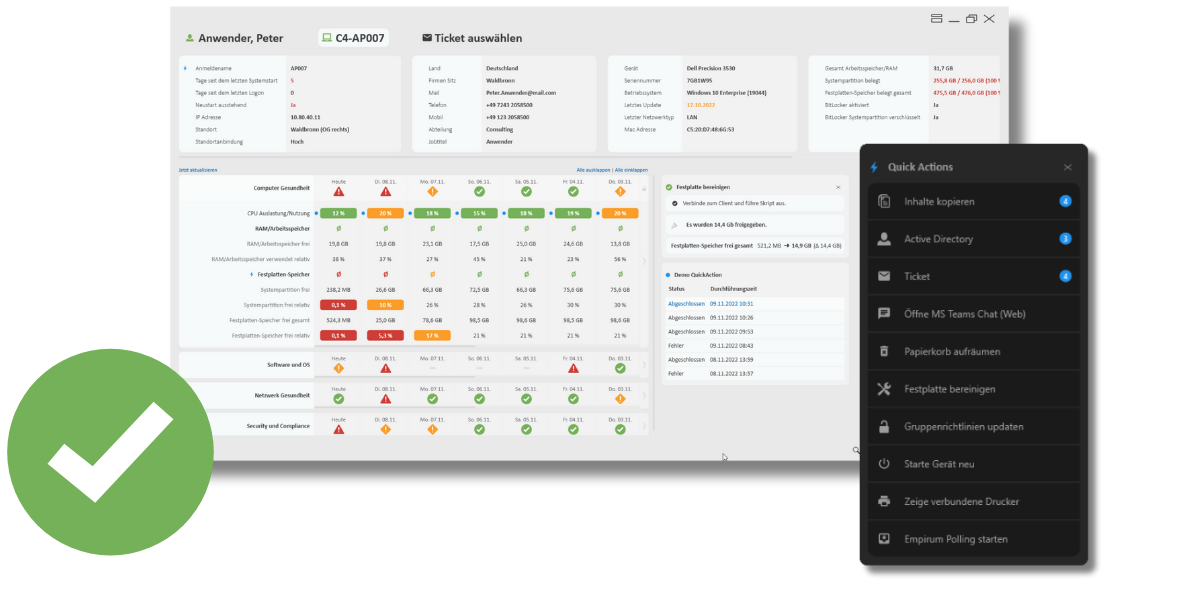
For example, theF4SD tool, which we designed specifically for first-level support, can serve as a technical foundation for greater transparency and efficiency in the help desk: The application stands out above all for its clear presentation of relevant client and device information. Help desk staff can see at a glance in the so-called F4SD Cockpit which asset is involved, what its health status is, and which metrics are good or critical. This means that potential causes of issues can be identified within seconds without lengthy research.
In addition, there are simple, automated solutions in the form of “Quick Actions,” which allow employees to resolve common issues—such as a full hard drive, an update, or a pending reboot—with a single click. The relevant ticket documentation is generated semi-automatically as the issue is being resolved.
A debunked misconception: The impression of laziness or incompetence is eliminated thanks to the quick insights and solutions provided by F4SD. The impression of arrogance is also dispelled, as there is no longer a need for interrogations that are perceived as humiliating. There are no more long wait times, and the user does not get the impression that they are not a priority or are being ignored.
F4SD - The Three Biggest Benefits
1. Real-time analytics and overview
Benefits: F4SD offers an intuitive dashboard interface that enables real-time analysis of affected clients. This means that help desk staff can immediately get an overview of a system’s status and identify the causes of existing issues much more quickly.
Example: When a call comes in, the agent immediately sees the most important information about the caller’s client and device. They don’t have to ask for the client number or the specific device involved. Nor do they have to conduct a tedious interrogation about the technical details of the issue or consult dozens of different research tools. This often eliminates the need for so-called “on-site IT support”: The help desk employee doesn’t have to connect remotely or go to the user’s computer in person to assess the situation.
2. Increased efficiency through Quick Actions
Benefits: By providing script-based solutions in the form of "Quick Actions" for common standard scenarios, help desk staff can resolve issues in a matter of seconds—sometimes with just a single click—and in some cases even while the user is still on the phone.
Example: A full hard drive slows down the computer's performance and speed and causes frequent system crashes. With F4SD, the full hard drive is immediately identified as the cause and can be cleaned up using the built-in "Clean Up Hard Drive" quick action.
3. Automated Documentation
Benefits: Documentation is partially automated, and tickets can be processed directlyfrom F4SDthanks to integration capabilities with existing service desk applications such asMatrix42. This saves time and reduces the workload on help desk staff, allowing them to move directly to the next ticket once a ticket has been closed.
Example: When a case has been successfully resolved, the ticket can be closed immediately, and all steps taken to resolve it are automatically documented.
General Approaches
There are a variety of approaches to making first-level support and IT in general more professional and approachable.
We have summarized a few helpful tips below:
1. Tools and Technology
In addition to F4SD, there are other technical options for presenting things in the best light. When it comes to cost transparency, for example, a professional service catalog like the one from Matrix42 can help. This not only allows users to book devices and services as if in an online store, but it can also show exactly what each one costs. In this way, it makes the value of assets and services visible and is likely to open the eyes of many users.
2. Ongoing training and professional development
Regular training and professional development—such as through ourAcademy —keep the team up to date with the latest technology and enhance their skills. This leads to faster and more efficient problem-solving.
3. Improved communication and collaboration
Open lines of communication and regular team meetings promote knowledge sharing and collaboration. This strengthens team spirit and ensures that problems can be resolved more quickly.
4. De-escalation Training and Conflict Management
When users call with a problem, they’re usually not in the best of moods. In such situations, specific communication strategies and de-escalating language can work wonders. While there are courses and training programs available, simply raising awareness among first-level support staff can already help foster a bit more tact and sensitivity.
5. Work-Life Balance
A good work-life balance reduces stress and increases employee satisfaction. This leads to better performance, lower staff turnover, and also helps employees become more resilient when dealing with stressful situations.
You can find tips on this in our blog post“Resilience in the Service Desk – Strategies and Tips”.
The Unsung Heroes: Why the Help Desk Is So Important
So prejudices are just what they always are: prejudices. You can safely toss them in the trash and focus instead on the real people behind the tickets—the ones who step in to help when a client is in need. Help desk staff are, after all, nothing less than the unsung heroes of a modern company. They serve as the link between technical systems and users.
Their work is crucial for:
- Quick problem resolution: Without an efficient help desk, many technical issues would go unnoticed or be resolved too late.
- User satisfaction: A good help desk ensures that users are satisfied and can continue their work without major interruptions.
- Corporate Productivity: By providing quick and effective solutions to problems, the help desk makes a significant contribution to the productivity of the entire company.
From “Hidden Heroes” to the shining heroes of everyday life

Prejudices about help desks and IT staff are widespread, but the reality shows just how important this role is to the company. With the right tools and strategies, help desk staff can not only work more efficiently but also find greater joy and satisfaction in their work.
F4SD provides the perfect support to transform the help desk into a high-performing unit. Through real-time analytics, quick actions, and efficient knowledge management, these unsung heroes are brought to the forefront, and their work is made significantly easier. In addition, ongoing training, improved communication, a healthy work-life balance, and recognition contribute to the team’s satisfaction and productivity.
Let’s work together to ensure that help desk staff receive the recognition and support they deserve. Turn your help desk teams into your company’s true superheroes!