Union Investment values transparency
Along with trustworthiness and professionalism, transparency is one of the most important values for service companies. This is especially true in the banking sector. With increasing digitalization and the growing outsourcing of internal services, the demand for transparency is becoming a whole new challenge—and this is also the case at Union IT-Services GmbH. The company recognized the need for action. The Nexthink software promised to provide a solution.
The Union Investment Group stands out among financial service providers for its financial expertise, security, and professional fund management. To focus on its core competencies, the subsidiary Union IT-Services also collaborates with other service providers—for example, in the area of IT support. This approach is quite common in the industry. It offers advantages, such as streamlining internal staffing and cost structures. But as is often the case, there are two sides to this approach.
“Outsourcing our IT support means that we no longer manage the client environment ourselves. As a result, we lost some transparency in this area and had to rely on information from the service provider,” explains Thomas Liss, Senior IT Infrastructure Manager at Union IT-Services GmbH. “That’s not to say we don’t trust them. But we wanted to know where problems or opportunities for improvement existed so we could prevent disruptions from occurring in the first place.” Ultimately, a project was launched in 2018 with the goal of improving transparency and service quality in the client environment. To gain clarity on requirements and potential solutions, those responsible for IT operations for PC workstations decided to thoroughly investigate the underlying issues.
The Path to Workplace Management
“What bothered us most was the fact that, for incidents that hadn’t been resolved to our satisfaction, we had to submit a request to the service provider to obtain the technical details, since some of them were only available in the service provider’s ticket system. We always received the necessary information with a delay,” explains Liss.
“Alternatively, we had to go to great lengths to try to figure out what had gone wrong. But in some cases, that was simply no longer possible after the fact. It was just as time-consuming to obtain ad hoc information outside of the agreed-upon reporting schedule—the kind of information we need, for example, to get an overview of the software installed on the clients and the corresponding versions.” All in all, such a process takes a lot of time and ultimately leads to unproductivity and, consequently, dissatisfaction among end users.
“We were no longer willing to put up with this situation,” Liss says in retrospect. “It was clear to us that we had to find a way to save time and costs while improving our internal service overall. With this goal in mind, we tried to define our requirements more precisely and launched a preliminary study with the help of a consulting firm. At first, we didn’t know exactly where we were headed—but it was moving in the direction of application monitoring.”
However, as the study progressed, the project leaders moved away from the idea of focusing on applications. The results showed that the main issue was the lack of an overview of the client as a whole—comprising hardware, software, and services. Consequently, they shifted their focus to workplace and client analytics, which was much more in line with the established goals.
In the subsequent market analysis for a solution, one of the requirements was: “The introduction of the tool should enable issues to be proactively identified as early as possible. At the same time, it should allow for the identification of sustainable solutions and their rapid implementation.” With this in mind, all end-user experience monitoring tools available on the market were examined and compared. The result was clear: with its combination of real-time analytics and detailed visualizations of all client processes, Nexthink simply best met the described requirements.
“Nexthink offers a unique approach that connects all endpoints in real time with end-user feedback,” explains Liss. “The result: transparency regarding clients, increased workplace productivity, and an improved end-user experience. We then tested Nexthink in the preliminary study to see what the solution could actually do. And lo and behold: the new dashboards provided us with detailed insights into the clients, existing issues, and health status—exactly what we were looking for! Nexthink proved to be the perfect solution to restore our overview of IT services and drive improvements in this area.”
The technical implementation – a potential record-breaker
Nexthink was the obvious choice. To ensure a professional implementation, a call for proposals was issued to find a suitable system integrator. Consulting4IT GmbH was among the bidders. As a Nexthink specialist, the company had already laid a solid foundation for the decision through numerous preliminary discussions and ultimately won us over with its many years of expertise. “In fact, there was really only one in-person meeting, and that was our first meeting in February 2020 at our offices in Frankfurt,” recalls Liss. “From then on, all meetings took place remotely due to the COVID-19 pandemic. It was unusual, but it still worked out exceptionally well.”
However, the restrictions brought on by the pandemic were not the real challenge. “The hardest part was getting everyone involved in the project on the same page,” explains Liss. “From our own department to the data protection officer and the works council—everyone had different requirements and had to be involved accordingly. For example, the works council was concerned with anonymizing user data, while we needed a comprehensive overview of the clients so we could analyze and resolve the root causes of problems. This led to several rounds of internal discussions until everything worked out for all parties.”
Overall, the project team at Union Investment had estimated that the technical implementation would be significantly more time-consuming than it actually turned out to be. The rapid implementation came as a pleasant surprise during the course of the project. “We hadn’t expected that with an environment of nearly 7,000 clients,” Liss admits. “Normally, with an implementation like this, you assume that the technical work will take up the majority of the time. That’s why we couldn’t believe it when Consulting4IT told us that the technical part would be completed within three weeks. We were certain it would take at least six months and even requested more service days in the proposal—but we were way off!”
In fact, the implementation was completed in just a few weeks in late summer 2020. David Hajduk-Kürschner, Customer Success Specialist at Consulting4IT, recalls with a smile: “Based on our experience, we knew pretty much exactly how much time we needed to budget. Thomas and his colleagues just wouldn’t believe us. But we were able to prove it in the end.” Liss adds with a laugh: “I was totally baffled and asked, ‘Is that it?’ It felt like the fastest project in the history of Union Investment.”
People as a Key to Success
According to Hajduk-Kürschner, the fact that things ultimately went so well was primarily due to the people involved. “The team simply had the right people. Whether it was organization, communication, or supporting one another—the responsibilities within the project fit together perfectly. Everyone was able to bring their personal strengths to the project and contribute to its success. In my opinion, this dynamic was the cornerstone of the project’s success,” he says with absolute conviction. And Christine Pagel, Group Leader for Workplace (WPL) and Platform and Workplace Services (PWS), sums it up with satisfaction: “It was simply the right mix, both professionally and personally.”
As Hajduk-Kürschner shares another brief anecdote from the project, everyone involved nods in agreement, thereby confirming the importance of the human factor: “It was during the pandemic, and we could only meet remotely. But once we started addressing each other informally, it felt like the project really gained momentum.” Liss continues on the topic: “Communication and internal coordination are definitely crucial. Above all, involving all relevant parties—such as the works council—early on is essential. It’s also important to always negotiate constructively and as equals.”
Another issue that should not be overlooked is the training of employees who will eventually be using the new tool. To ensure they acquire the necessary skills from the very beginning, Union IT-Services placed great emphasis on comprehensive training sessions. These were conducted on-site by an experienced trainer from Consulting4IT.
Making emotions measurable
In her role as group leader, Christine Pagel is responsible for all IT processes in the workplace environment. For her, the benefits of the tool are clear: “The Nexthink solution shed light on the so-called ‘black box client’ in one fell swoop,” she explains. “The dashboards give us direct insight into existing issues. We can now often identify the causes ourselves—that is, independently of the service provider—at a glance. This enables us to respond to problems or disruptions much more quickly and effectively. Above all, this means contributing to the company’s success. After all, if the PCs—which are our primary tools—aren’t working, no one can work, and that slows the company down. That’s why it’s all the more important that client devices perform well and that problems can be detected and resolved early on. With Nexthink, all of this now happens much faster, bringing us a big step closer to one of our main goals: providing the company’s employees with a positive service experience with their IT department.”
But that's not all—Pagel also emphasizes that Nexthink has led to a real improvement in working conditions for the IT department staff themselves. Not least because many aspects that were previously based on subjective impressions have now become measurable.
Nexthink as a milestone
Liss explains: “Many IT services are still provided by external vendors. Nexthink, however, is one of the first solutions to have been developed entirely in-house. This allows us, as service managers, to maintain an overview of the services provided and their quality throughout the entire infrastructure. If there are any discrepancies, we can work with our vendors on specific improvements. Furthermore, with Nexthink, we are able to intervene in a corrective or even proactive manner when necessary. This is because the application allows us to identify risks before they become acute problems. Take the rollout of new software, for example: Using a dashboard in Nexthink, we can closely monitor whether the software is impacting client performance or causing more crashes. No matter how much testing you do beforehand, real-time information like this is worth its weight in gold.”
For Liss and Pagel, there is no doubt that Nexthink represents a true milestone for Union Investment on the path to optimized service quality. And there are already further plans for this powerful tool. “The next big step is moving to the cloud so we can always get the latest features and functions as early as possible. This should also significantly reduce maintenance costs,” says Liss. “After that, we’ll be implementing it in our user help desk.”
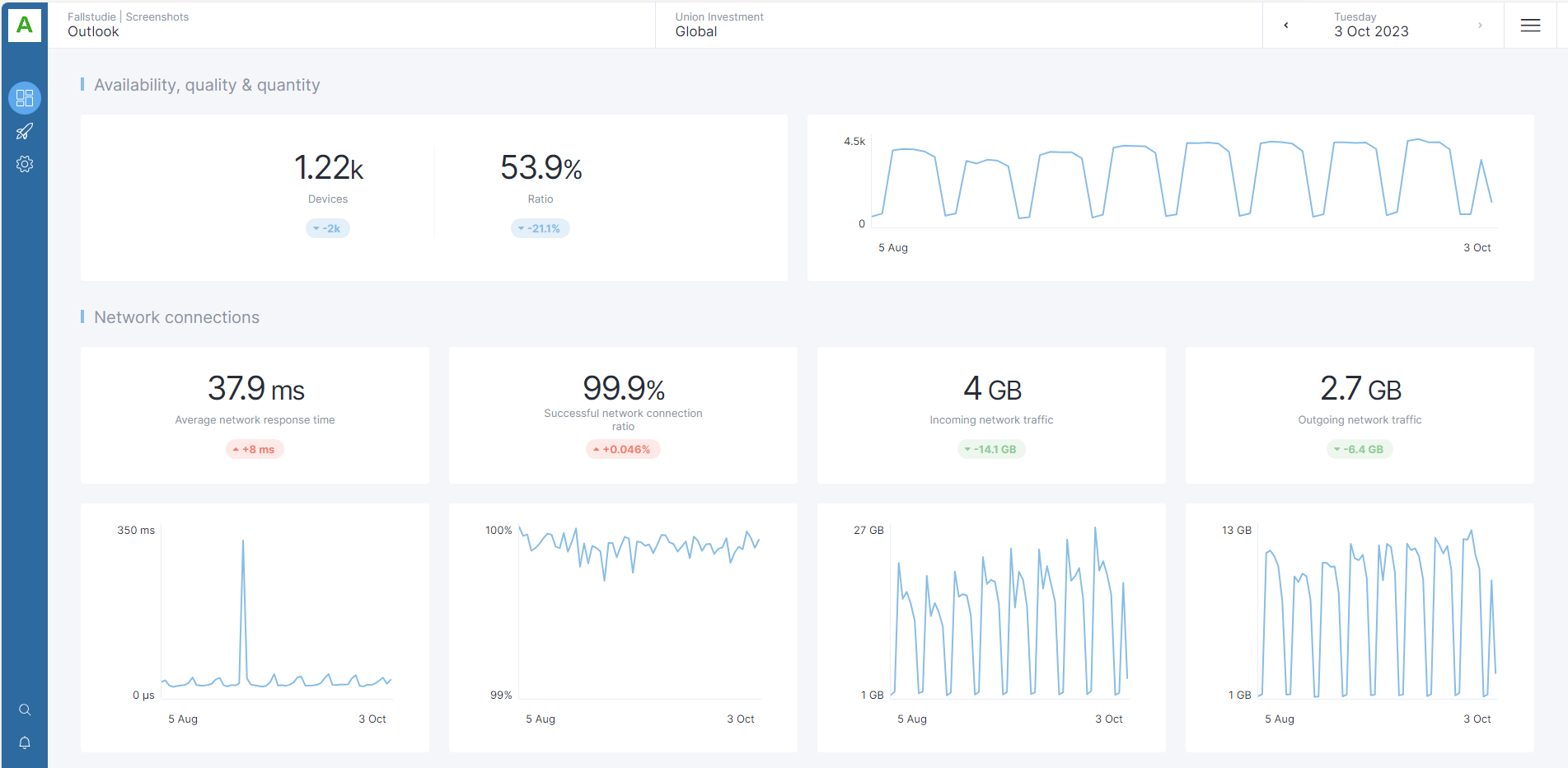
Pagel adds: “With Nexthink, our colleagues at the UHD will have access to a dashboard that shows them, for example, which computers need driver updates or have full hard drives. This will enable them to work much more efficiently, which in turn will reduce the number of inquiries and support tickets. We are currently in the process of preparing for this.”
Another milestone involves implementing proactive actions directly from the dashboards. Liss and Pagel envision recommendations and action items that would allow common issues to be resolved within seconds with a single click. The two IT experts plan to discuss how this could be implemented with their partners at Consulting4IT as soon as the project is ready. Nexthink—according to the unanimous conclusion at Union IT-Services—is already paying off as a sustainable investment in transparency and service quality.
About Union Investment
With over 66 years of experience, Union Investment—which employs 4,348 people—develops and manages investment solutions for private and institutional investors. Today, with approximately €424.1 billion in client assets under management, Union Investment is one of the largest fund providers in Germany. 5.8 million clients entrust their assets to the fund company across 1,337 funds.