
The City of Konstanz is using Matrix42 to bring administration and IT closer together
There is a shortage of IT staff almost everywhere. The situation is particularly critical in public administrations. This is no different at the City of Konstanz. There, one technician supports an average of 154 users—nearly twice as many as the recommended “KGSt guideline” of 1 to 85. Tensions between IT and users are bound to arise. But not in Konstanz. Because there, IT has its systems and processes perfectly under control.
The City of Konstanz’s approach was unusual from the start. When a company wants to optimize its IT processes, it typically starts with the help desk. A ticketing system with predefined workflows takes a lot of work off the IT department’s hands and, thanks to its transparency, ensures greater user satisfaction. In Konstanz, however, asset and contract management were introduced first. This was because Siegfried Ehrlinspiel, the IT manager in Konstanz, had a pressing problem. He was frustrated that the management of his assets and contracts was incomplete, cumbersome, and redundant.
“Our team was split into two groups,” he explains: “There was the procurement and administration side, where a business administrator managed all the contracts using software from a Swiss company. But that system didn’t track serial numbers or other inventory data—in short, none of the information that identifies our assets.” The situation was exacerbated by the fact that the city of Konstanz had leased its equipment at the time, and the devices were completely replaced every four years in batches.
On the other hand, there were the IT specialists, whom Ehrlinspiel affectionately calls “our nerds.” They didn’t necessarily settle for what was available to them, but instead gathered whatever they needed from wherever they could find it. This, in turn, didn’t fit into the “administrators’” plan, as it threatened to further erode their already patchy overview. “The rift between the two factions grew ever wider,” recalls the IT chief.
The Curse of Doing Good
With just under 14 staff positions, the City of Konstanz’s IT department is severely understaffed. IT Director Siegfried Ehrlinspiel could certainly use significantly more employees. After all, the team manages around 240 specialized applications and approximately 1,150 end devices. In addition, it handles about 600 tickets per month, which are expected to be resolved quickly. For managing to accomplish most of this, the IT department receives top marks from users. But ideally, nothing should go wrong.“We don’t have sufficient backup coverage, and we have far too few—if any—resources to tackle new initiatives such as digitizing processes for citizen services or internal workflows,” says Ehrlinspiel. Deep down, however, the IT director is also immensely proud of his efficient team.
Help yourself—and optimize
When the business administrator previously responsible for contract management took on a new professional challenge in 2014, a direct replacement was not possible due to other IT plans. Consequently, Ehrlinspiel recognized the need for a fundamental optimization of IT service processes. He discarded the software solution, which lacked key features, and ensured that Matrix42’s asset and contract management tools were implemented. As he had previously determined, these tools are specifically tailored to the needs of both IT and business users. The integration of asset and contract management combines both perspectives into a unified approach.
“Help yourself, and you will be helped”—that’s Ehrlinspiel’s motto. Applied to this specific situation, it means: “If you don’t have enough staff, you’ll just have to optimize your own workflow.” Ehrlinspiel enlisted his trainees and “dual-track students” to transfer the existing contracts from the administrative software. “I was lucky that our trainees weren’t interested in doing the same thing over and over. Instead, they wanted to be challenged and encouraged. Another stroke of luck was that virtually all of them wanted to stay, and I was able to keep them.” With more than 200 software maintenance contracts stored in the management system and on paper, this work took nearly a year, but that time was simply necessary, and Ehrlinspiel was happy to invest it.

Measures to Combat Phantom Budgets
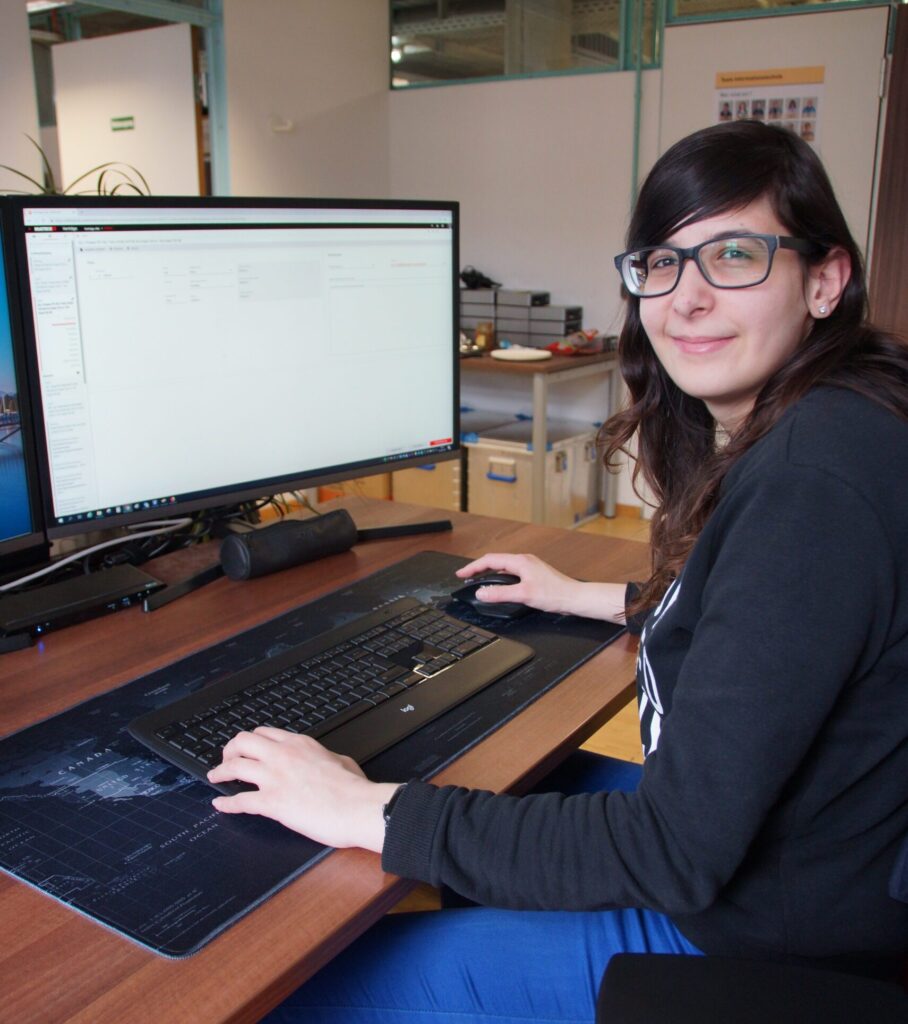
Marina Müller is a prime example of just how capable the trainees in Konstanz are. The young woman had just started her first year of the dual study program when Matrix42 was set to be implemented. Yet she was already entrusted with the important task of overseeing the transfer of contract data. The data from the old system was automatically imported into Matrix42, but it had to be supplemented and edited afterward. So it would be fair to say that the software was implemented by trainees—with the help of a consulting firm, of course.
Ehrlinspiel’s experience with his first consulting partner, however, was less than ideal. “He was very knowledgeable about the technical details of the software,” the IT director praises—only to immediately follow up with his criticism: “What he lacked was the know-how to use the tools properly to support administrative processes.” Although Ehrlinspiel controls the entire IT budget, he cannot simply spend it as he sees fit. Rather, he must allocate it to initiatives or procurements that are often requested well in advance by the relevant departments. Konstanz generally plans “two-year budgets” that span two years.
To ensure that the annual budget is not exceeded or underutilized, it is essential to accurately track not only the reported needs but also ongoing obligations—such as those arising from maintenance contracts—for the period in question. Otherwise, you end up working with phantom budgets that inevitably spiral out of control. “We need cost plans that truly show us how high our obligations are this year or next, and software that displays this at the push of a button,” Ehrlinspiel summarizes.
A good consultant must be able to say no
“Working with our first consultant was a real struggle,” Ehrlinspiel reports. “We just couldn’t get the contract management system up and running the way we’d envisioned it. At that point, I really thought Matrix42 had been the wrong choice, and I almost scrapped the whole thing.” As a last resort, however, the IT specialist tried one more option: “I googled to see if there might be another consultant out there.” And that’s how he came across Consulting4IT from Waldbronn, a Matrix42 Platinum Partner.
There, they were willing to delve deeper into the issue and explore solutions that, while not forcing the software to conform to our needs, aren’t immediately obvious unless you’re very familiar with the tool. “We realized as early as the first workshop what mistakes we had made,” Ehrlinspiel remarks in amazement. Sometimes, he explains, you simply can’t transfer your own ideas directly into the tool; instead, you should follow the tool’s “philosophy,” which is ITIL-compliant and thus highly standardized: “In some areas, you simply have to align with the standard; otherwise, the software may lose its ability to update.”
Consequently, Ehrlinspiel recognized the need for a fundamental optimization of IT service processes. He discarded the software solution, which lacked key information, and ensured that Matrix42’s asset and contract management tools were implemented. As he had previously determined, these tools are specifically tailored to the needs of both IT and business users. The combination of asset and contract management unites both perspectives in an integrated approach. “Help yourself, and you will be helped,” is Ehrlinspiel’s motto.
In Ehrlinspiel’s view, a suitable consulting partner must possess three key competencies above all else: They must know what the software is actually capable of; they must be able to listen so they understand what makes the client tick and what they actually want; and they must be able to implement exactly that using the software’s capabilities. “Matrix42 is a wonderful tool,” says the IT manager, “but it’s complex, and you have to know how to use it properly.” And then it occurs to him that there is a fourth, no less important skill that a good consultant should possess: “They must be able to say no when the customer wants something that compromises functional safety.”
Approved requirements become a "planned contract"
Working with Consulting4IT, the City of Konstanz found an end-to-end solution that leverages the contract management framework. The key is not merely that some terms previously in use have been replaced with the tool’s terminology. To simplify financial control, for example, submitted and approved requests are immediately created as “planned contracts.”
“Matrix42’s contract management system recognizes different phases of the contract lifecycle,” explains Joachim Benz, Head of Consulting at Consulting4IT. “This means that even a need that hasn’t been met yet can be created as a draft contract and activated later.” In this way, projects that are only planned for the time being can be recorded in contract management—and thus in the cost plan—along with the resulting fixed costs. The data only needs to be entered once, but can also be used for project management.
In the near future, the Matrix42 "Service Catalog" module will even be used for this process; with its shopping cart and tracking features, it offers a high degree of transparency. This allows requesters to track the budget approval process.
In addition, with the help of his consultant, Ehrlinspiel has implemented a few changes to the process that further reduce his costs. One of these concerns software licenses. The contract management system sends users an email once a year informing them of the cost of using their software over the next twelve months. Users are then required to actively confirm that they wish to continue using the program. If they no longer need it, users click on a link in the email, and the timely termination of the contract is forwarded as a task to the responsible department. In fact, users also have the option to access the contracts related to their software throughout the year. This eliminates the need for analog, redundant contract storage. Furthermore, this creates even greater transparency for contract holders, which in turn fosters a sense of shared responsibility. For most people, this is a far more effective regulatory mechanism than bans and restrictions could ever be.
Software as a Team-Building Activity
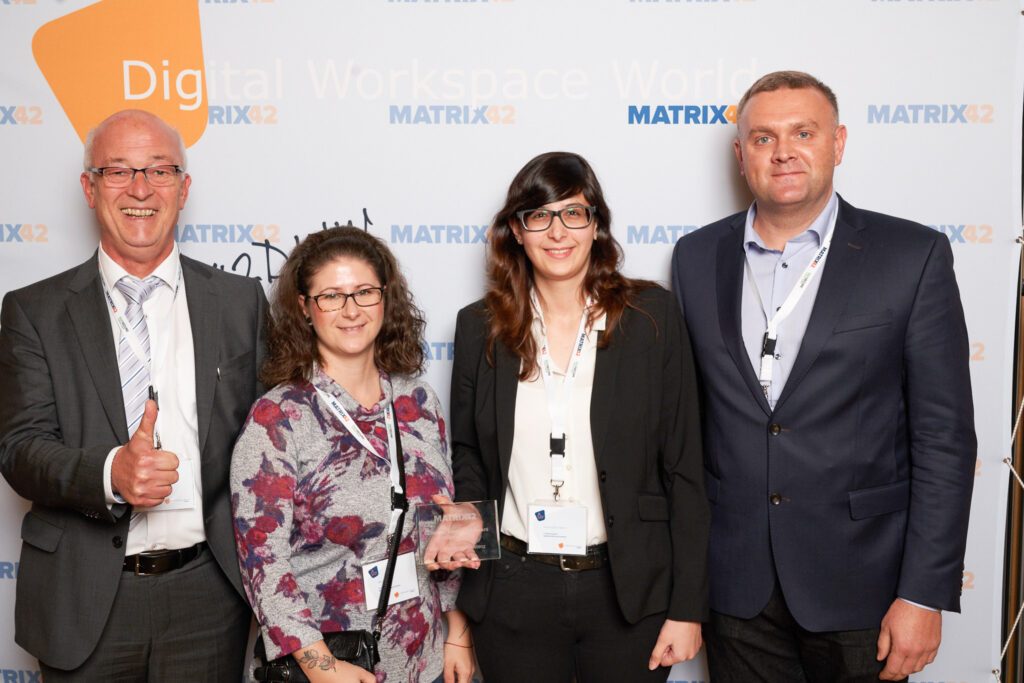
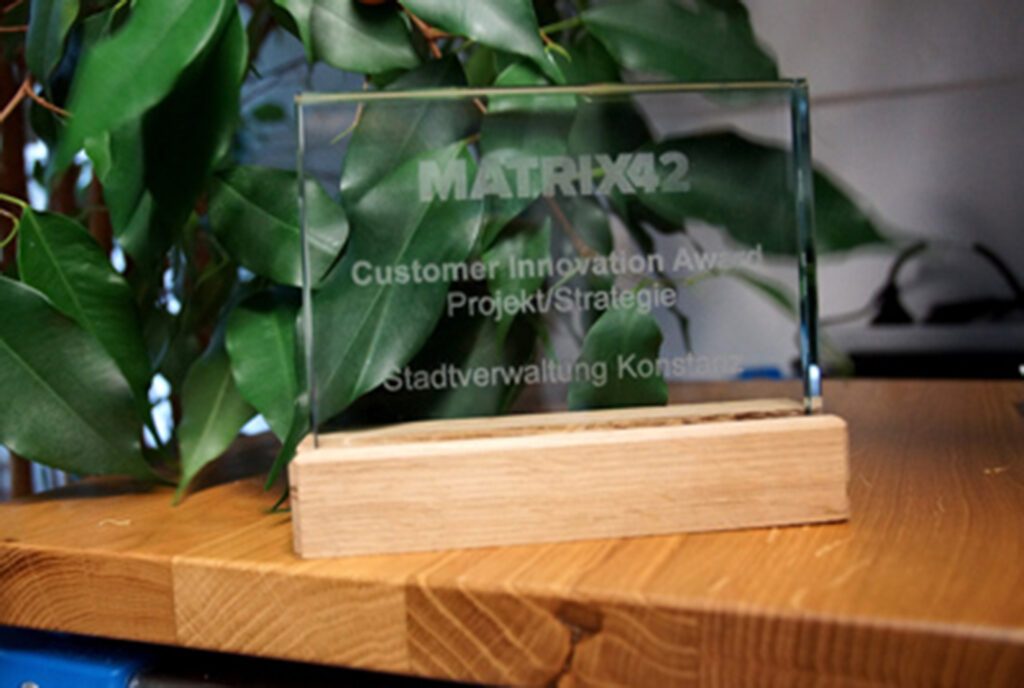
Ehrlinspiel’s team has now implemented nearly the entire Matrix42 suite. “Now, whenever we want to do something with internal processes, we always think of Matrix42 first,” confirms Immacolata Fasano, who is already part of the next “generation” of IT trainees: “Of course, the modules of the Matrix42 system shouldn’t lose their technical functionality, but we try, as far as the technical functions allow, to use them to map non-IT processes as well. “Fasano personally managed and supported one of these projects during her training; it’s called ‘KernG’sund’ and helps with the processing and administration of requests for health-promoting measures. Last year, it was honored with the ‘Customer Innovation Award’ by the software manufacturer Matrix42. Other non-IT projects that have been implemented include the management of official seals and requests for supplies.”
In addition, the resourceful IT team has developed several features around Matrix42 to make their work easier. These include an extensive knowledge base that stores solutions to common problems. This allows trainees to start working on the hotline after just three weeks, says Ehrlinspiel. The fact that users can create their own tickets has already improved the service. And now, a student will even be working on a Matrix42-based chatbot for the knowledge base as part of his bachelor’s thesis. This “digital assistant” could essentially take over first-level—or at least half-level—support.
In addition to the purely financial and operational benefits, Ehrlinspiel insists that the implementation of Matrix42 has even helped improve the work environment: “The fact that we all use a common interface fosters a sense of community and appreciation for our colleagues’ work. We’re now all in the same boat, in full view of everyone. Everyone is aware of their part in the success. This way, what were previously two separate teams—Administration and IT—have become one; the divide between them has closed.”
Exchange with other municipal governments
A welcome side effect of working with Consulting4IT is the “community” of Matrix42 users. For example, there is a public administration working group that meets regularly. “We’re all at different stages with the individual modules, so we can learn from one another,” explains Ehrlinspiel: “For example, we sent our program administrators to Radolfzell for a day so they could demonstrate how we handled contract management. On the other hand, we’ll soon be visiting the City of Reutlingen to see the MALM and EgoSecure add-ons developed by Consulting4IT in live operation and to benefit from Reutlingen’s experience with the implementation.”
Mobile Asset Lifecycle Management (MALM) is at the top of Ehrlinspiel’s wish list. With the help of this tool from Waldbronn, IT devices and their contract terms can be assigned simply by scanning a barcode. This feature can save customers a tremendous amount of tedious work. So far, the rollout in Konstanz has been postponed due to a lack of resources.Consulting4IT supports industry-specific working groups and is happy to participate in them. Ehrlinspiel knows why: “That way, they don’t have to explain a workflow over and over again, but can inform several customers at once.”