
ESM in the Construction Industry - Habau Group Embraces Process Digitalization
When planning and building office complexes, residential developments, or public buildings, every step of the process must work together seamlessly.It’s no longer just about sharp pencils on technical drawings, motivated construction crews, or powerful yellow machines. In the highly competitive construction industry, the leaders are those who are also at the forefront of digital innovation.
Habau Hoch- und Tiefbaugesellschaft m.b.H., headquartered in Upper Austria, recognized this as well. As Austria’s fourth-largest construction company, it serves as the parent company of the Habau Group, which comprises more than 15 subsidiaries. Given the group’s complex structure, the company realized the need to expand its digital automation processes and establish comprehensive standards—particularly in the area of IT management.
Digital Construction Site Service Bookings
“Our biggest internal challenge was managing service bookings,” explains Florian Hintersteininger, Team Leader for Client Infrastructure at Habau Hoch- und Tiefbaugesellschaft m.b.H. “We did have a tool for this, but it was quite cumbersome to use. To integrate all the necessary information, we had to pull data from various third-party systems. That involved an enormous amount of manual work. Furthermore, it wasn’t clear who had booked which services, and there were no established procedures for adding services after the fact. Another drawback: we had virtually no transparency regarding costs and billing.”
Florian Hintersteininger knew exactly what he wanted: a unified and comprehensive solution. In fact, he didn’t have to look far to find it. One of the Habau Group’s subsidiaries wasalreadysuccessfully usingMatrix42. “As a rule, similar tasks arise throughout a group like ours—across all subsidiaries. That’s why we were convinced that it would make sense to implement a single solution across the entire group. Especially since Matrix42 perfectly met our requirements: a comprehensive solution for IT service management, including a service desk, asset management, and a service catalog.”
More Than Just Standard – The Path to Becoming an Expert
No sooner said than done—Hintersteininger initially contracted Matrix42 directly for implementation and a maintenance agreement. “The first step was to roll out the service desk,” he recalls. “Next, we planned to focus on asset management and the service catalog.” In the meantime, however, additional requirements had emerged that went beyond Matrix42’s standard offerings. For example, it was important to Hintersteininger to be able to track service requests that had already been fulfilled and to make service delivery more comprehensive and user-friendly. He also wanted the solution to map the employee lifecycle—onboarding and offboarding.
“We assumed we weren’t the only company with such requirements. That’s why we looked for a Matrix42 service provider that offered standardized add-ons,” he explains. “Eventually, we came across Consulting4IT, whose Matrix42 Custom Packs met our expectations.” Hintersteininger took a step-by-step approach to implementing these add-ons. “We wanted to test how the collaboration would work first. That’s why we started by implementing Matrix42 Asset Management. Once that had been implemented to our satisfaction, weaddedthe Consulting4IT add-onMALM.” With MALM—Mobile Asset Lifecycle Manager—he and his team gained a powerful tool for the automated management and monitoring of the entire lifecycle of IT assets—a first step toward transparency and cost control within the company.
Among other things, Service Catalog Plus allows organizations to retroactively record services rendered and to expand the scope of services as needed. In addition, the Custom Pack includes a comprehensive module for mapping the entire employee lifecycle. For example, when an employee joins the company, the necessary services, devices, and permissions can be easily and flexibly requested via the self-service portal, and personnel data can be recorded. The APALIMA (“Advanced Package Lifecycle Management”) module included in Service Catalog Plus was also very well received by Hintersteininger. This ensures that when users order software, they automatically receive the latest version, which is also continuously updated automatically.
The Big Picture – Challenges and Lessons Learned
The implementation of a group-wide system always presents technical and organizational challenges. Hintersteininger recalls: “Migrating our subsidiary’s existing configuration to the group platform was no easy task. Furthermore, we initially focused heavily on asset management, assuming that this would also allow us to organize the billing of IT services. After all, asset management had always been the basis for our billing in the past, as cumbersome and opaque as it had been. In hindsight, we should have started with the service catalog, but it took a bit of persuasion on Consulting4IT’s part to get us to change our mindset.”
Once the asset management phase was complete and it came time to configure the service catalog, a new challenge arose: the tool needed to be capable of handling both service requests and the visualization of IT dependencies for certification and audit purposes. Consequently, the technical adjustments required were extensive in order to reconcile these two use cases. “Fortunately, we were able to find a solution that allowed for both its primary use as a service catalog and its use as a monitoring tool for audits,” explains Hintersteininger.
Overall, according to the IT team leader, it would have been better to give more thought to the big picture beforehand. “But that was also because, at the time, we didn’t yet know how everything fit together and where we wanted to map which processes and how,” he explains. “Of course, you can’t know or plan everything in advance. Nevertheless, it’s advisable to examine the logical relationships between products and processes before the project starts.”
A Perfect Match: How Personal Contribution and Process Experience Complement Each Other
Ultimately, all modules were successfully implemented. A key factor in this success was the significant in-house contribution made by the Habau Group, while Consulting4IT provided support primarily through its extensive process expertise. From valuable insights and project coordination to technical support and the provision of technical expertise through its in-house academy, Consulting4IT stood by the Habau Group throughout the entire project, offering both advice and practical assistance. “It was very important to us to receive support, especially in terms of processes,” said Hintersteininger. “After all, it was clear to us from the start that we couldn’t compensate for missing processes with technology alone.”Consulting4IT also impressed with its exceptionally fast response times in support. “Whenever there were problems, someone was always there quickly. That was very reassuring and helped us move the project forward swiftly,” emphasizes Hintersteininger.
Automation and significant time savings
Overall, the implementation and expansion of the service desk, asset management, and service catalog, as well as the introduction of the Consulting4IT Custom Packs, significantly reduced the workload on the IT department, increased transparency, and led to a noticeable reduction in costs. A key benefit was the “Service Catalog Plus” Custom Pack, which enables the automation of onboarding and offboarding processes, as well as the introduction of the Consulting4IT add-on MALM, which digitally tracks and automatically updates the current inventory status across various locations. “With MALM, we always have an overview of inventory status, and the data is captured automatically. This has saved us a lot of manual effort. Service Catalog Plus has significantly expanded the functionality of service bookings and includes valuable features such as Password Self Service or time-limited services.”
“Of course, thestandard scope hadto be adapted slightly to our company’s specific needs, but that was accomplished in just a few days of service,” says Hintersteininger, summarizing: “Basically, it can be said that tasks that used to require full-time positions can now be completed in just a few hours a month.” The integration of all modules now enables the group’s employees to easily order hardware, software, and services via the Matrix42 Self Service Portal—just like in an online store. In the background, the necessary processes are triggered automatically: approval requests, provisioning, and billing. This enables a relatively small IT team to process orders, service requests, and tickets with virtually no friction.
Conclusion: Digital processes as the foundation
The outlook for the future is clear: The Habau Group plans to implement further optimizations and expand automation to other areas of the business, such as facility management. “We want to continue evolving and gradually integrate as many business areas as possible. We’re also excited about Consulting4IT’s latest in-house development for the service desk: First Aid Service Desk, or F4SD for short. We plan to take a closer look at that in the near future,” Hintersteininger announces.
The conclusion drawn by both Hintersteininger and Consutling4IT from the project speaks for itself: well-designed automation processes and a solid digital foundation are the cornerstones of a modern business. They are the building blocks of the future—especially in the construction industry.
About Habau Group
The Habau Group is an internationally active construction group headquartered in Austria that was founded in 1913. With over 6,700 employees and numerous subsidiaries, the company operates in the fields of building construction, civil engineering, pipeline and underground construction, and the construction of industrial facilities. The Group focuses on innovation and sustainability to carry out challenging construction projects in Europe and beyond. As a leading provider in the construction industry, the Habau Group is known for its expertise and broad range of services.
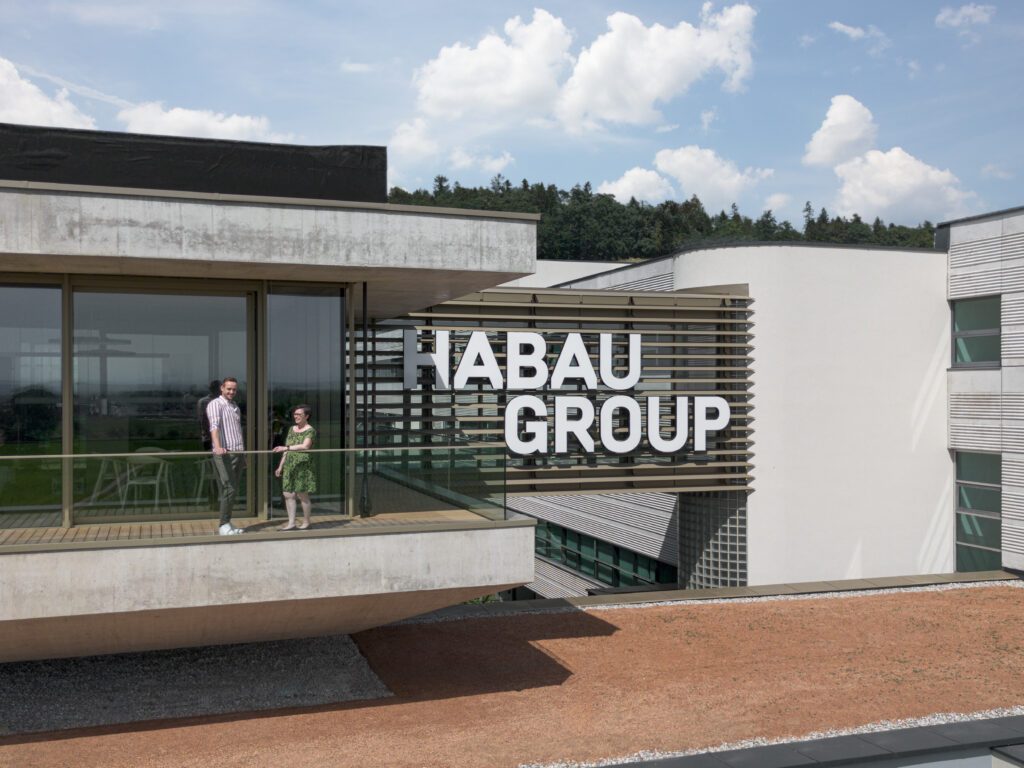
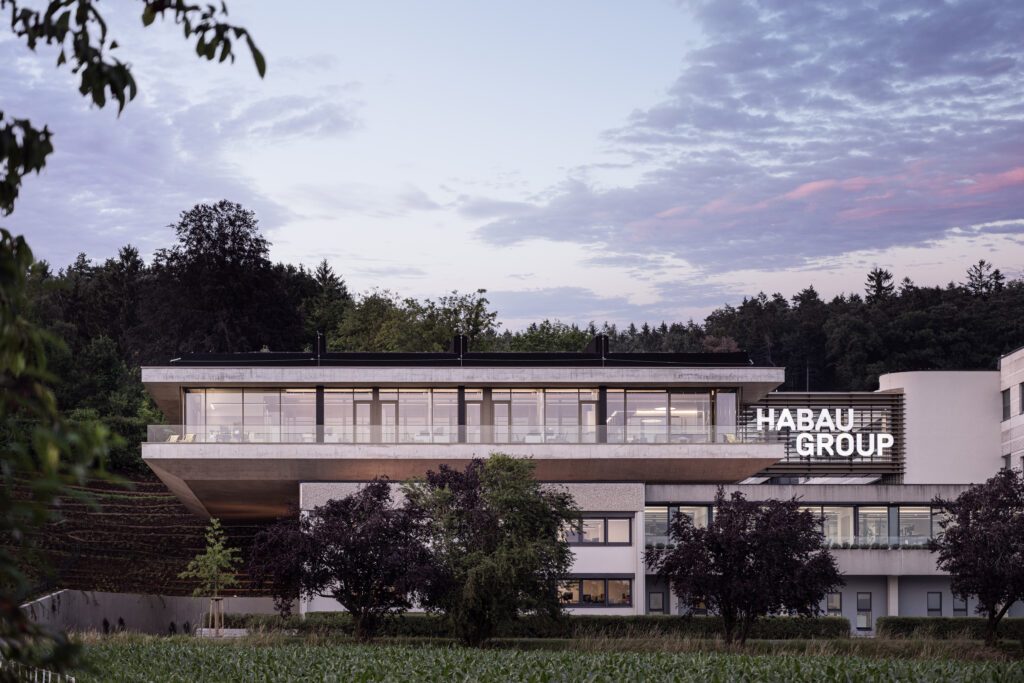
All images © MW Architectural Photography / HABAU GROUP