
In our blog series, we introduce the key figures behind our IT analytics service. This time, our expert Yunus Karakya, Presales IT Analytics, shares his experiences and insights on IT analytics, compliance, and IT security.
With over 15 years of experience in the IT industry and a particular focus on IT processes and IT security, Yunus has established himself as a sought-after expert on our Analytics Team. Yunus shares his insights with us on the growing complexity of the IT landscape and the importance of IT analytics in today’s world.
Yunus, what can you tell us about your professional background?
I’ve been working in IT for about 15 years, the last six of which have been at Consulting4IT. I started at a medium-sized company before eventually joining Matrix42. There, I helped build up areas such as the ticketing system, service desk, and asset management practically from the ground up. I’ve also always been interested in IT security and immersed myself deeply in the subject while at Matrix42. This led to me eventually being appointed as the IT security officer and serving in a staff position that reported directly to management. At some point, however, I wanted to be more involved in specific projects and work more directly with people, which ultimately led me to Consulting4IT.
My experience over the past decade and a half has taught me that IT is always about people. And given the increasing complexity of the issues at hand, it is all the more important not only to break them down into processes that are as simple as possible, but also to engage people through effective communication.
You say that the IT landscape is becoming increasingly complex. What has changed in this area in recent years? And how can IT analytics help address this?
It is a fact: IT staff are faced with increasingly complex tasks. For example, in recent years, more and more technologies have had to be deployed in the cloud. Users must be provided with tools that empower them in their work. At the same time, more and more issues need to be resolved. It is therefore very important for everyone involved to prevent such issues from arising in the first place—certainly more important than simply having systems that flag issues that have already occurred or enable retrospective documentation. And this is exactly where IT analytics comes in: analyzing data to identify negative trends early on and thus prevent problems before they arise. Data collection itself is nothing new. What has changed is the increasing focus on proactivity.
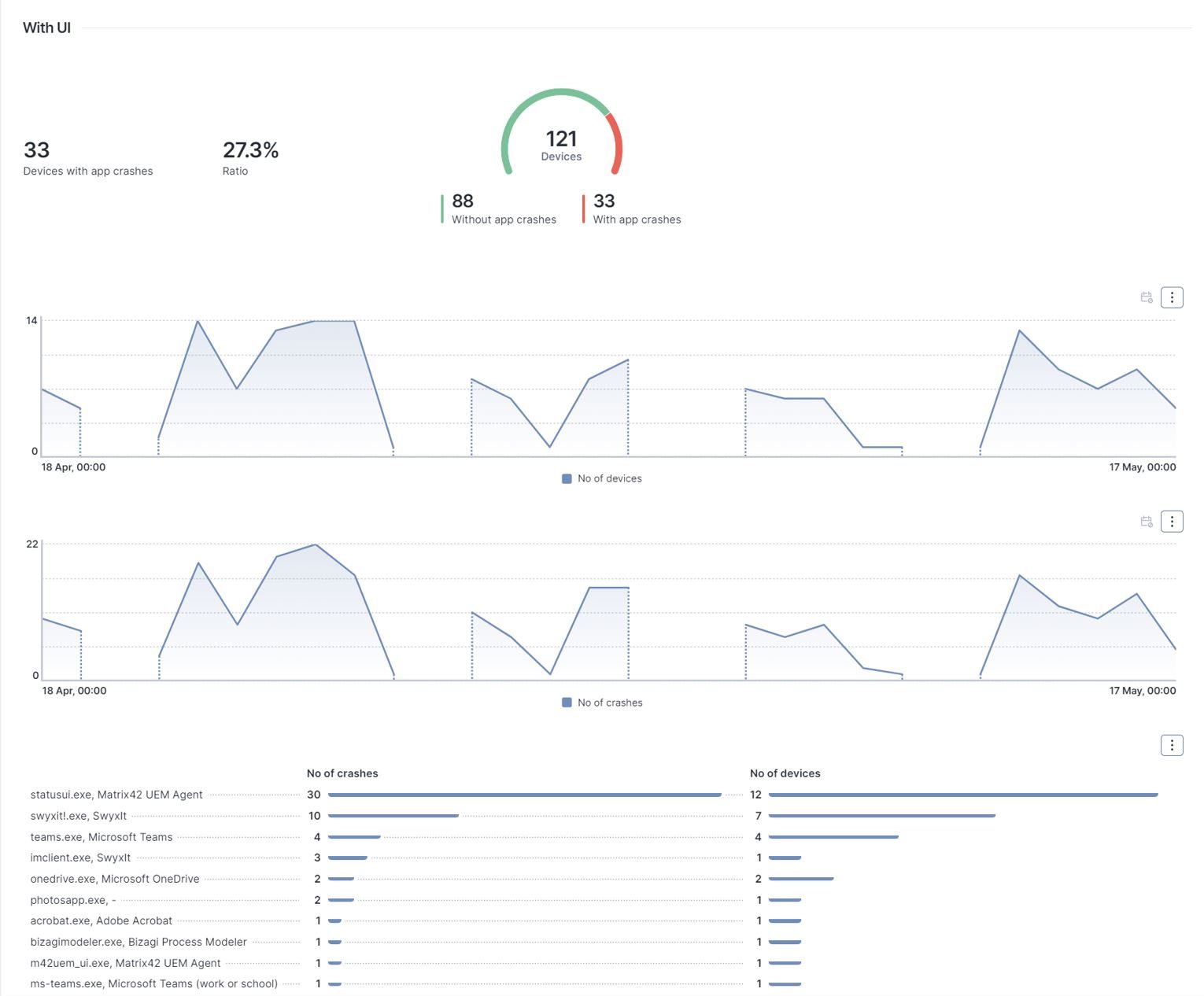
This also has to do with the maturity level of customer environments, as I have observed time and again in Matrix42 projects over the past few years: The first step is always to establish incident management processes, define SLAs, or ensure clean master data. In incident management in particular, the main focus is on responding quickly and effectively—a problem arises, and you fix it. Once all of this has been successfully implemented, the next step should follow: proactive problem management based on IT analytics, to stay ahead of the big waves in IT support. In other words, before a problem occurs for the user and they have to call support. This topic therefore also has a significant impact on the end-user experience. After all, nothing frustrates a user more than a PC that takes too long to boot up in the morning or constant application crashes.
Where can IT analytics be applied, and to what extent does it contribute to a company's success?
To invest in innovation and thereby position my business for the future, I need the right information. This doesn’t just mean knowing which asset is on which floor and that a particular device is malfunctioning. Instead, it means being able to identify anomalies in that device in advance and respond accordingly. Only if this can be achieved on a large scale can the overall number of fault reports be reduced. This boosts user productivity and motivation, and IT can focus on other, more important IT projects that ensure the company’s long-term competitiveness.
And that brings us to the next point: data is also crucial to the success of IT projects. A hot topic right now, for example, is Windows 11 migration. Projects like this never go completely smoothly. So it would be great if I could immediately identify which devices are experiencing issues during the migration process and whether, for instance, a business application is crashing frequently during the migration phase. That way, I can respond in a timely manner and take proactive measures. With IT analytics, we can optimize the entire lifecycle of an IT project, minimize risks, and improve quality assurance. This not only saves time but also reduces costs. And as a bonus, it also lowers the blood pressure of everyone involved.
How can our DEXOps service help with this?
Data is everywhere—we have the tools, the expertise, and the people to analyze it.Our consultants, whom I sometimes affectionately refer to as “data moles,” gain daily insights into various client environments as part of our DEXOps service. From this, they continuously gain a wealth of experience and knowledge, which helps them identify similar issues with other clients more quickly. Apart from that, they can focus entirely on daily health checks at the client’s site and regularly check in on how the clients are doing. Corporate IT departments simply don’t have the time or staff for this. If any anomalies are detected during these checks, our consultants report them to the client immediately and provide direct, actionable recommendations. This enables effective problem management without the client having to invest significant time and manpower.
In summary, IT analytics can support proactive problem management as well as project management and quality assurance. What role does it play in the areas of IT security and compliance?
IT security is, by its very nature, a very broad topic. It starts with ensuring compliance with regulatory requirements. In my role in presales, I see this every day when I put a prospective customer’s IT environment through its paces. It’s always like opening a surprise egg, because the fact is: today’s work environments are highly dynamic. People typically have an incredible number of applications and workflows. Keeping track of everything and ensuring compliance is a major challenge for companies.
Take browsers, for example: Compliance guidelines typically stipulate that you should always have the latest browser version installed to avoid security vulnerabilities. Most companies believe they are in pretty good shape in this regard. However, I repeatedly find that, on average, 50 to 150 different versions are installed. This isn’t necessarily the IT department’s fault, as there are countless different reasons and circumstances why this happens. For instance, browser or Windows updates often fail to install on a client machine simply because the hard drive is too full. But compliance starts with having transparency regarding the software versions on all client machines and ensuring that the software in use is always up to date—or, for example, that consistent BitLocker encryption is enabled on all devices.
UsingNexthink asan analytics tool, we can easily assess the current situation and identify opportunities for improvement. As part of our service, we do this on a daily basis, provide recommendations for action, and, if necessary, assist in addressing security vulnerabilities.
In other words, using IT Analytics and Nexthink as tools makes it easier to comply with compliance policies. What about specific incidents or suspected violations?
Beyond ensuring compliance with regulatory requirements, Nexthink also makes it possible to detect anomalies that may indicate a security incident. For example, Nexthink can identify a compromised endpoint (client) that establishes an unusual connection to an unknown external IP address. The application focuses on the client’s perspective, allowing us to detect everything that occurs between the client and the server or network. This means that if a client uses unusual network connections that appear suspicious to our consultants, we immediately notify the customer and may thus be able to prevent an incident.
Incidentally, our service really pays off when it comes to these kinds of issues. After all, analytics offers us a wide range of technological capabilities that allow us to use intelligent methods to check for anomalies. Our experts, however, are deeply immersed in our clients’ systems and infrastructures on a daily basis and, through their focus and targeted work with the available data, can gain entirely different insights. They also benefit from their often years of experience and frequently identify anomalies much faster than the systems themselves. That’s why, in my opinion, the combination of technology and human expertise is crucial. Because in the end, I always need a person who can draw the right conclusions from the data.
In your experience, what common challenges do you see recurring in companies that can be addressed using IT analytics?
In my experience, the same issues keep cropping up. A classic example is BitLocker encryption. For a variety of reasons, many companies often fail to ensure comprehensive encryption across their mobile devices.This is where we cansupportour customers right out of the box withNexthink . Typically, right at the start of our collaboration, we offer to work together to check which clients are encrypted with BitLocker, what the update status of the devices is, and which ones experience a particularly high number of crashes. It’s essentially like a health check for compliance.
Of course, decision-makers are generally aware of these challenges and issues, but they often don’t know where to start or how to tackle them. We help them identify the right levers to pull by providing the necessary information. And that’s the key: We handle all the groundwork using appropriate analytics tools and generate all the necessary information along with targeted recommendations for action.
In your opinion, what are the biggest challenges our clients are currently facing? Can you give a specific example of a situation where IT analytics can make a significant difference?
This brings me right back to the topic of Windows 11 migration. It’s a hot-button issue that many of our customers are currently grappling with. Many companies are currently dealing with hardware that only runs on Windows 11. In other words, the need to switch to the new operating system is very real. But the IT departments in charge are currently a bit overwhelmed by this. They often don’t know how to tackle the issue. After all, the operating system is a fundamental building block for the clients, and that’s not somethingyou can just whip up.With Nexthink, we can deliver all the information needed for the migration virtually out of the box. This way, IT knows exactly where to start to move from Windows 10 to 11.
IT analytics can therefore also help with the implementation of major IT projects. What additional value does it offer in terms of management?
When it comes to new IT projects, the challenge is always to convince management or senior decision-makers of the need for them. With Nexthink, we can provide our customers with dedicated dashboards that clearly display security vulnerabilities, root causes of issues, and other data. This allows IT managers to demonstrate problems based on data, thereby providing a concrete basis for decision-making. IT is no longer a matter of guesswork. Problems can be addressed at their root and tackled in a targeted manner.
How do you see the future of IT analytics?
IT analytics is definitely going to grow in importance. This is partly because we can expect technological innovations in IT at ever-shorter intervals, and the issues involved are becoming increasingly complex. This means that the use of external services and SaaS applications will increase, whether for client management, IT security, or other areas. As a result, companies will no longer host many services on their own servers. Instead, the resources will be located somewhere out there on the wild web, which in turn means that companies will no longer be able to tinker with the backend themselves. Added to this is the relatively limited IT workforce and the rise of flexible working. Users must be able to work from anywhere—whether from home, the company headquarters, or another location.
With IT Analytics, companies acting as service owners can monitor and effectively manage cloud-based services in terms of implementation and quality. In addition, IT Analytics allows me to consistently track the quality of the user experience for my users, whether regarding cloud applications or the quality of work across different locations. I can identify bottlenecks, pinpoint the root causes of problems in a timely manner, and prevent disruptions. I simply have all the necessary information to act in a targeted manner and ensure the best possible employee experience for my users.
How will AI impact this field?
Automation has always been a key topic in IT, and it is more important today than ever before. Incident and problem management, in particular, offer significant potential in this area, which can be effectively leveraged through IT analytics. These developments have been underway for some time now. Nexthink is a true pioneer in this field—think self-service.
Example: I launch Teams, but it keeps crashing. How great would it be if an application running in the background immediately detected that I’m having a problem, identified the cause, and automatically notified me with a suggested solution—all without any interaction from IT. I wouldn’t have to call them or submit a ticket; I could just press a button and be back up and running right away. And in IT, employees can focus on more critical issues or important projects. In my opinion, that’s what the future will look like.
Conclusion: IT Analytics as a forward-looking concept
Yunus Karakaya makes it clear thatIT analyticsis the key to proactive IT management and the optimization of complex projects. He emphasizes that it is not just about resolving issues, but above all about preventing problems. Through regular data analysis, IT teams can respond in a timely manner and save resources in the long term. Transparency and the right information base play a central role in this process.
Our DEXOps service plays a key role in helping organizations effectively leverage internal IT data and gain a decisive advantage in both incident management and strategic IT projects—all in the interest of ensuring the long-term sustainability of businesses.