
In our latest blog series, we’ll introduce you to the key figures behind our IT Analytics Team and our DEXOps Service. We’ll start with Matthias Hellwig, Team Lead in the Service Delivery division.
Matthias is responsible for optimizing our clients’ IT infrastructures through strategic data analysis, thereby providing them not only with greater transparency but also with improved responsiveness to IT issues. In this context, our specializedDEXOPs servicefocuses on enhancing the efficiency and effectiveness of our clients’ IT systems through regular data analysis and proactive recommendations for action. In this interview, Matthias provides exclusive insights into his daily work, explains what IT analytics entails, and outlines specific use cases. He also details the added value companies gain from it and what makes our service approach so unique.
Matthias, you have had an impressive career in the IT industry. Can you tell us a bit about your professional background?
I worked as an infrastructure consultant for about 25 years, covering a wide range of technical topics. My experience spans from analyzing network environments and client-server issues to email systems and large-scale data archives.
What is your role at Consulting4IT?
I’ve been with Consulting4IT for almost two years now and lead the Service Delivery team in the IT Analytics division. My role is to ensure the high quality of service delivery for our clients.
How does the experience you've gained throughout your career help you with your current work with clients?
My experience helps me immensely in understanding and effectively addressing the challenges our clients face today. It’s always interesting to see how certain issues remain unchanged over the years. The simplest example: restarting a computer. Failing to restart a computer for an extended period caused problems 20 years ago, and it still does today. And just as it was back then, a simple restart of the device usually does the trick. In many different situations, you simply need to know the specific cause—and that’s only possible with comprehensive data transparency. We can provide that with IT Analytics. I’m excited to continue exploring this topic at Consulting4IT and to incorporate my experience into my current daily work.
The topic of IT analytics is often still perceived as very abstract. Could you briefly explain what IT analytics actually is? And how does problem management fit into this?
IT analytics enables organizations to gain transparency into their IT infrastructure through comprehensive data analysis. This allows them to identify the root causes of recurring issues and develop sustainable solutions. Furthermore, regular analyses of IT data enable the identification and monitoring of abnormal trends and outliers. This empowers corporate IT departments to act proactively before disruptions even occur. IT analytics thus forms the foundation for proactive problem management: preventing disruptions before they arise.
How can IT analytics be performed?
To perform such analyses, you first need a software solution likeNexthink. Such a tool provides the technical foundation for continuously monitoring IT environments through real-time data analysis, comprehensive dashboards, and automated solutions. Of course, to make full use of such a tool, you also need a certain level of technical expertise regarding the tool itself, but above all, regarding the interpretation of the results.
What challenges do companies face when it comes to developing a professional IT analytics strategy?
It should be noted up front that many companies are not yet fully aware of the potential of IT analytics and have therefore never explored the topic in depth.
On the other hand, there are certainly companies that are already using applications likeNexthink. The problem is that, for cost reasons, most of them cannot afford a dedicated analytics team focused exclusively on data analysis. However, the existing IT department lacks the time and expertise to actively work with the solution—after all, it already has too many issues on its plate. Instead, the software is used purely reactively. This means that whenever there is a massive spike in similar incidents, the software is pulled out of the drawer to address the immediate problem. Most of the time, however, there is a lack of experience, so working with it remains time-consuming and exhausting. Naturally, purchasing an analytics solution doesn’t pay off this way, because its true potential isn’t being realized at all.
How do we address this customer dilemma, and what does our offering look like in this context?
We don’t just want to sell our customers an analytics tool; we want to offer data analysis as a service. Even with the best tool, many companies find it difficult to draw meaningful conclusions from the vast amount of data. This requires not only the necessary time but also a great deal of expertise and experience. That is why we offer IT Analytics as a comprehensive service, in which our experts take full charge of the process. Thanks to their knowledge, years of experience, and dedicated focus, they are able to identify specific weaknesses in the customer’s IT infrastructure, propose improvement measures, and proactively optimize them in collaboration with the customer.
What is the process for a customer when they book our service?
It is always important to me to emphasize that we truly do whatever is necessary for our clients and do not limit ourselves to the bare minimum. Theprocess following the signing of the contract therefore proceeds as follows:
1. Onboarding
There is an initial service onboarding session during which you work with the customer to determine which areas are important for daily analysis.
2. Content Workshops
Then there are usually two or three content workshops where we show the client what we can achieve together and how the process might work.
3. Maintenance Service
The process then moves on to the configuration service. If any specific issues are identified, they are promptly reported to the customer, and we coordinate with them on how to address them.
4. Recommendations for Action and In-Depth Analysis
We will then assist with finding a solution, make recommendations, or conduct a more in-depth analysis.
What specific topics are covered during onboarding?
Our service always includes a standard set of metrics that we monitor for all customers. During onboarding, we also work with each customer to define a customized set of information and metrics that they want to have monitored on an ongoing basis—for example, because they pertain to their most critical applications. The corresponding workflows behind this can be very extensive, especially when they consist of many components such as application servers, terminal and database servers, and file storage systems. This results in a customized set of metrics that we later monitor daily in the customer’s system.
What steps should we take if the control service detects deviations or anomalies in the data? What can we offer our customers?
If our regular analyses reveal anomalies that suggest a negative trend, we monitor them and proactively provide the client with information and recommendations for action. In addition, upon consultation, we also assist the client in implementing specific solutions. For example, if it is necessary to create PowerShell scripts to resolve issues directly on the client’s end, we will develop these scripts after consulting with the client. In other words, we also handle the implementation when the client assigns us the relevant task.
What else is included in our DEXOps service?
We see ourselves as a source of inspiration, and during regular workshops we work with the client to develop user stories—in other words, we explore where IT analytics could provide additional value. Ideally, the client comes up with their own ideas here, because after all, they know best where further benefits could be realized. Sometimes, however, the client is overwhelmed by the wide range of possibilities and doesn’t know what to do with them. For such cases, we’ve developed a kind of standard content based on our years of project experience. Drawing from this portfolio of practical options, we can then make specific suggestions for each area to highlight where there may still be room for optimization.
Our service thus covers everything related to analytics—offered as a kind of ongoing subscription. Customers can always count on having someone in the background who checks their system daily, monitors for anomalies, and alerts them if a problem is looming. Ultimately, this service provides proactive updates and offers appropriate recommendations for action.
What is our technical approach to providing our services?
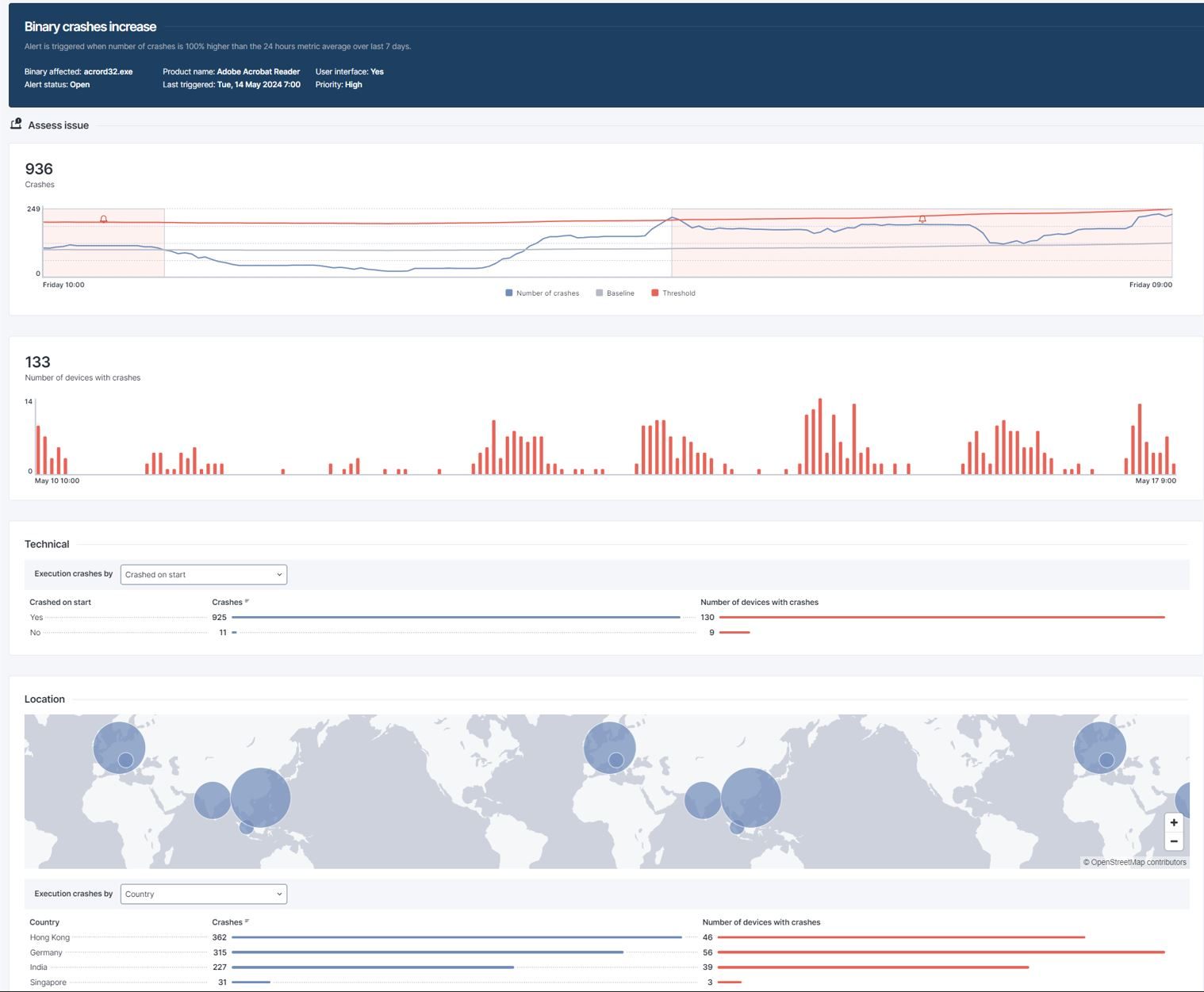
Our fundamental approach is to view IT data from the client’s perspective and achieve transparency across the entire chain. This means that we use our analysis tool to examine what each user experiences on their PC and how data flows travel through the network to cloud applications. In doing so, we use specialized collectors to automatically gather a wide range of client data—including information on events and system specifications such as hard drive size or RAM and CPU utilization. All of this data is automatically transmitted to a cloud-based database, which allows us to run highly targeted queries, such as: Show me all devices that experienced Microsoft Teams crashes in the last seven days. Such information is stored as a history for up to 30 days, allowing you to identify trends or anomalies in specific clients even in retrospect.
In this context, can you explain how IT analytics can reduce first-level incidents?
Basically, there are two possibilities: In the first case, there is a problem somewhere that keeps causing the same issues over and over again—for example, an application that responds too slowly. The customer’s IT department wants to resolve the issue and contacts us for help. We can then use targeted data analysis to determine the cause and provide instructions on how to resolve the issue. On the other hand, it can also happen that during our regular analyses, we notice that a certain value is behaving strangely. This is often still within a range where users don’t even notice it yet. However, if such a trend continues in a negative direction, it can change abruptly at some point—namely, exactly when a certain threshold value is reached.
The result: a flood of calls to first-level support, as all users try to report the issue at once. However, by proactively monitoring the suspect value and visualizing what happens over a certain period of time, we can stay one step ahead and respond early with specific guidance and recommendations.
This effectively reduces the workload on IT support. How does this affect companies overall?
IT analytics enables us to identify IT issues and address them systematically. This enables us, together with our customers, to prevent user disruptions before they occur—or at least resolve them before they escalate. This leads to a significant reduction in incidents at the first level of support. Operationally, this means less downtime and more efficient use of IT resources, which in turn has a positive impact on our customers’ business operations.
Can you give a specific real-life example?
Sure—we had a case, for example, where we noticed at a client’s site that one of their most critical applications was crashing constantly. The reason: A patch deployed the previous day via patch management had severely restricted the application’s functionality. Fortunately, we were able to identify the issue very early on that day. This allowed us to respond and resolve the situation together with the customer’s IT team before the application’s primary users had even started working with it. There was no need for escalation, which saved both the users and the service desk a lot of stress.
How would you summarize the benefits of the service?
The data transparency provided by our service makes it possible to quickly identify the causes of various issues and develop specific recommendations for our customers. In addition, by monitoring trends, we can identify emerging IT problems and help prevent issues before they occur. Furthermore, the service offers our customers the clear benefit that their systems are actively monitored and continuously analyzed without them having to invest significant time and manpower themselves.
The problem management system established in this way helps reduce incidents, thereby easing the burden on the entire IT department—and especially on IT support. It also ensures the smooth operation of all systems, leading to an improved user experience and increased productivity in line with the company’s goals.
IT Analytics and DEXOps – The Foundation of Proactive Problem Management
The conversation with Matthias makes it clear: IT analytics enables proactive problem management when companies take a close look at it. However, companies often lack both the necessary staff and sufficient time to do so.
However, this challenge can be addressed by outsourcing analytical tasks to experienced experts. Daily checks, focused monitoring of IT systems, proactive recommendations for action, and support in resolving operational issues—the possibilities offered by suchan external serviceare extensive, and the achievable benefits are significant. They range from significantly reducing the IT department’s workload by minimizing incidents to boosting productivity and enhancing the user experience.
The best outcome, however, is that corporate IT departments regain time—time they can invest in other projects and thus actively drive the company’s ongoing digital transformation, for example—a key factor in ensuring a company’s future viability.